
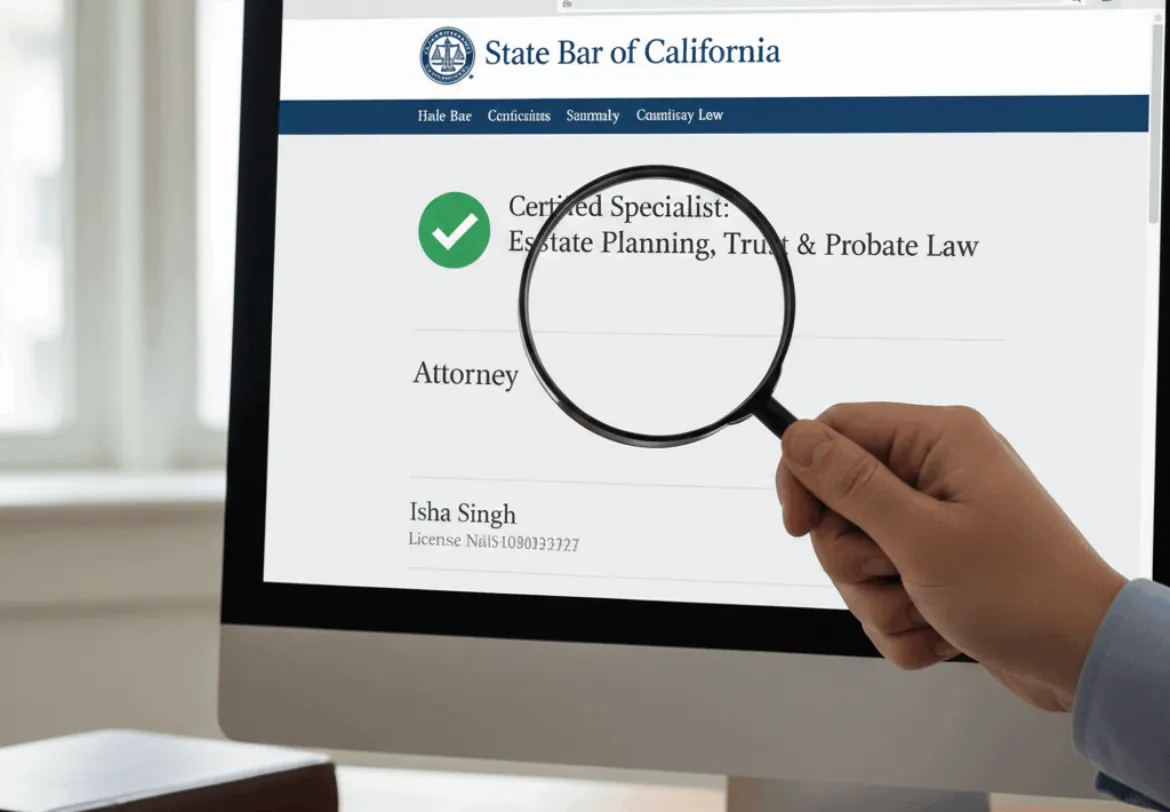
You can find the right California estate planning attorney by taking 3 simple steps:
- Step 1: Verify their State Bar certification,
- Step 2: Interview 2-3 specialists,
- Step 3: Check for California-specific expertise.
But here’s what nobody tells you.
Most attorneys who claim to “do estate planning” actually spend 80% of their time on divorce or personal injury cases. They’re dabbling, and your family will pay the price later.
This guide shows you exactly how to find an estate planning attorney with practical yet easy steps. But that’s not at all.. No sir!
I will tell you the top-ranking Californian estate planning attorneys with a cost estimation and a list of red flags that you need to avoid.
- Find a real expert: Check California State Bar certification, read reviews, and interview 2-3 attorneys who focus 75%+ on estate planning.
- Avoid dabblers & scams: Skip lawyers who do divorce or injury too; watch for fake awards and high-pressure sales.
- Match your needs: Pick specialists for elder law, special needs, blended families, farms, tech, or big businesses.
- Costs are flat fees: Basic will $300+, full trust $2,000–$4,000; complex plans $4,000–$8,000+.
- After signing, fund the trust: Transfer house, bank, and assets into the trust or it fails; review every 3–5 years.
How Do I Find a Reliable Estate Planning Attorney Near Me in California?
The best way to find an estate planning attorney is:
- Ask for referrals or talk to relatives/friends who have already availed these services,
- Or, check directories to lock down 4-5 options
- Read Google
- Schedule a meeting with 2-3 lawyers and choose the one that best fits you
Follow this step-by-step process to find qualified local attorneys.
Step 1: Search the California State Bar Database
Visit calbar.ca.gov and search for any attorney’s name. You’ll see their license status and any disciplinary actions.
The State Bar also has a Certified Specialist Search. Only board-certified estate planning attorneys appear in these results as they’ve passed extra exams and met strict experience requirements.
Step 2: Check Professional Directories
Look for attorneys on peer-reviewed platforms:
- Super Lawyers: Peer-nominated attorneys rated by practicing lawyers
- Best Lawyers: Based on professional surveys and years of experience
- ACTEC (American College of Trust and Estate Counsel): Invitation-only membership for top estate attorneys
- NAELA (National Academy of Elder Law Attorneys): Specialists in elder law issues
These aren’t perfect, but they’re far better than paid advertising directories.
Step 3: Read Real Reviews
Check Google Reviews, Yelp, and Avvo for client feedback. Look for patterns in reviews, not just star ratings.
Good signs in reviews:
- Attorneys who listen to family concerns
- Clear communication without jargon
- Follow-through after documents are signed
- Willingness to admit when something is outside their expertise
Step 4: Get Referrals from Trusted Sources
Ask your CPA, financial planner, or another attorney for recommendations. Professionals who work with estate planning attorneys daily know who does quality work.
Friends and family referrals can help too, especially if they have had a similar situation to yours.
Step 5: Schedule 2-3 Consultations
Talk with 2-3 estate planning attorneys to learn about their services. Most attorneys offer an initial consultation for $100-$300.
But wait….!
Isha Singh, a bar-approved and California-recognized attorney, offers a free 30-minute consultation.
Use this meeting to evaluate their California expertise, communication style, and approach. Never hire the first attorney you meet. Comparing 2-3 options helps you make an informed choice.
Can an Out-of-State Attorney Handle My California Estate Plan?
Usually not, and it’s risky to try.
California Rule 5.5 prohibits lawyers not admitted in California from practicing California law. An out-of-state attorney cannot prepare a California trust or will for California property.
Exception for snowbirds: If you split time between California and another state, you might need attorneys in both locations. They should coordinate to ensure your multi-state plan works properly.
Your primary residence state determines which attorney you need. If California is your main home, use a California-licensed attorney.
What Type of Estate Planning Attorney Do I Need in California?
Not all estate planning attorneys handle the same issues. Your situation determines which specialist you need.
Here are some estate planning attorneys to help with this matter:
1. Elder Law Specialists
When You Need One: Planning for long-term care, nursing homes, or Medi-Cal coverage.
Elder law attorneys focus on Medicaid asset protection rules. California has strict Medi-Cal asset tests, where you can only keep $2,000 in countable assets to qualify.
They also understand the 5-year lookback period for gifts. General estate planners often miss these crucial timing rules.
2. Special Needs Trust Attorneys
When You Need One: You have a disabled child or dependent receiving government benefits.
These attorneys create trusts that provide extra support without disqualifying your loved one from SSI or Medi-Cal.
A special needs trust “allows a disabled beneficiary to maintain assets while maintaining eligibility for public benefits.”
3. Blended Family & Community Property Specialists
When You Need One: Remarriage with stepchildren, or complex family dynamics.
California Family Code §721 can give stepchildren inheritance rights unless you explicitly address this. Standard trust templates won’t handle these situations properly.
These specialists ensure your estate plan reflects your actual wishes, not California’s default rules.
Do you need an all-in-one attorney? Talk to Isha Singh as she has expertise on matters like blended family, wills, trusts, and elderly laws….
And, oh, her 30-minute free session is something that you don’t want to miss, if you need urgent help!
4. Niche Specializations You Might Need
| Specialization | Who Needs This | Why It Matters |
| Farm/Ranch Succession | Central Valley agricultural families | Water rights, farmland valuation, and preventing forced sales to pay estate taxes |
| Tech Employee Specialists | Bay Area workers with equity compensation | RSUs, stock options, and cryptocurrency require special handling, or heirs lose value |
| Business Succession Planning | Business owners | Prevents months-long delays that can destroy a company during probate |
| Private Client Attorneys | Ultra-wealthy families ($10M+) | Advanced tax planning, trust litigation expertise, and multi-generational strategies |
Can a Family Law or Probate Attorney Handle Estate Planning?
Short answer: Yes, but they are not focused on other broad niches.
Probate attorneys settle estates after death. Their job is reacting to problems, not preventing them.
Estate planning attorneys prevent probate before death. They focus on proactive strategies to avoid court entirely.
Do I Need a Tax Attorney for My Estate Plan?
Most California families don’t need a dedicated tax attorney. California has no state estate tax.
Consider tax expertise if you have:
- Business assets worth over $2 million
- Multi-state property holdings
- Concerns about the federal estate tax (applies to estates over $13.99 million in 2025)
- Complex Prop 13 transfer situations
Often, your estate planning attorney will collaborate with your CPA. Only attorneys can legally create trusts, but CPAs handle the tax returns.
Solo Attorney vs. Boutique Firm vs. Large Law Firm: What’s Best for My California Estate Plan?
There are multiple lawyers in the estate planning niche. For example, a solo attorney works alone, a boutique is a medium-sized agency, and a large law firm is obviously LARGE.
Each type of practice has trade-offs. Here’s what to expect from each:
| Feature | Solo Attorney | Boutique Firm (2-5 lawyers) | Large Law Firm |
| Personal Attention | High – you work directly with one lawyer | High – small enough to know all clients personally | Lower – you may get passed to junior associates |
| Expertise Depth | Depends entirely on that one lawyer’s knowledge | Specialized estate planning team with complementary skills | Broad expertise across many practice areas |
| Continuity Risk | Usually low as they often fulfill their commitment | Low – team members cover for each other | Medium – large teams exist, but you may rotate lawyers |
| Cost | Usually, the lowest has less overhead, which means lower fees | Moderate – specialized service at fair pricing | Highest – big overhead and partner billing rates |
| Best For | Simple estates under $1M, straightforward situations | Most families, including those with complex needs and blended families | Ultra-high-net-worth clients ($10M+), business empires |
What Are the Best Estate Planning Lawyers in California?
California has thousands of estate planning attorneys. Here’s how to identify the truly excellent ones.
Top-Rated California Estate Planning Attorney
Isha Singh – Law Office of Isha Singh
Isha Singh consistently ranks among California’s top estate planning attorneys. She’s been named a Super Lawyers Rising Star for Trusts & Estates from 2022 to 2026.
Her firm focuses exclusively on California estate planning issues, including Proposition 13 transfers, living trusts, Medi-Cal planning, and community property strategies. The firm markets itself as “California’s highest rated estate planning law firm.”
How to Identify Other Top Attorneys
Peer-Reviewed Rankings (These Actually Mean Something)
- Super Lawyers: Attorneys nominated by peers, researched for experience and results
- Best Lawyers: Based on professional surveys across the legal community
- ACTEC Membership: Invitation-only fellowship for top estate planning lawyers
State Bar Certification (The Gold Standard for any Lawyer)
California’s Board Certification in Estate Planning, Trust & Probate Law is the state’s official credential. Certified specialists have passed rigorous exams and demonstrated extensive experience.
Only about 10% of California estate planning attorneys hold this certification. It’s the single most reliable indicator of expertise.
Professional Memberships That Signal Expertise
- ACTEC (American College of Trust and Estate Counsel) – Invitation-only, top estate lawyers nationwide
- NAELA (National Academy of Elder Law Attorneys) – Elder law and Medi-Cal planning specialists
Awards to Ignore Completely
Many “awards” on law firm websites are meaningless pay-to-play marketing schemes. If the attorney had to pay a fee to “claim” the award, it’s worthless.
Red flag awards:
- “Top 10 Attorney” from unknown organizations
- “America’s Most Honored Professionals”
- Any award requiring payment to display
Focus on State Bar certification, ACTEC membership, and genuine peer-reviewed rankings instead.
How Much Does Estate Planning Cost in California?
Most California estate planning attorneys charge flat fees for complete packages. This gives you predictable costs upfront.
Typical California Estate Planning Costs
The following is a list of estate planning costs based on their types:
| Plan Type | What’s Included | Typical Cost Range |
| Basic Will | Only your will to declare your heirs | Start from $300 |
| Basic Will Complete Package | Simple will + financial power of attorney + healthcare directive | $700 – $1,500 |
| Revocable Living Trust | Trust document + pour-over will + both powers of attorney + healthcare directive | $2,000 – $4,000 |
| Complex Estate Plan | Multiple trusts, business succession, special needs trusts, Medi-Cal planning | $4,000 – $8,000+ |
| Hourly Consultation | For specific questions or plan reviews | $300 – $600/hour |
Red Flags to Watch Out For When Choosing an Estate Planning Attorney
Here’s how to spot the attorneys and firms you should avoid.
1. Trust Mill Warning Signs
Trust mills are companies that mass-produce generic estate plans without customization.
Red flags that scream “trust mill”:
- High-pressure sales tactics: “Act now! Limited time offer!”
- Marketing through aggressive seminars or cold calls
- Pushy salespeople (not attorneys) conducting initial meetings
- One-size-fits-all documents that don’t ask about your specific situation
- Collecting detailed asset information before you’ve hired them (they use this for upselling)
- Very low prices that seem too good to be true ($500 for a “complete” trust)
Trust mill documents often fail to avoid probate. They don’t account for your specific family situation or California’s unique laws.
| One warning sign: firms that require you to bring detailed financial information to a “free” seminar. They’re building a sales database, not providing legal services. |
2. Fake Awards and Marketing Fluff
Does the attorney’s website display a dozen “Top Attorney” badges? That’s a red flag, not a credential.
Many “awards” are paid listings that require no vetting whatsoever. Any attorney can buy them.
Meaningless awards to ignore:
- Awards from organizations you’ve never heard of
- Certificates requiring payment to “claim” or display
- “America’s Most Honored Professionals”
- “Top 10 Under 40” from anonymous sources
Real credentials that matter:
- California State Bar Certified Specialist
- Super Lawyers (peer-reviewed, not paid)
- Best Lawyers (based on professional surveys)
- ACTEC membership (invitation only)
3. “Jack-of-All-Trades” Warning
Run from attorneys who advertise: “We handle divorce, criminal defense, immigration, personal injury, AND estate planning!”
Estate planning is complex. California’s community property rules, Prop 13 implications, and trust strategies require focused expertise.
An attorney who does everything probably masters nothing. You want someone who spends at least 75% of their practice on estate planning.
4. Other Red Flags to Watch For
Lack of California-specific knowledge:
- Doesn’t mention community property rules in initial consultation
- Unfamiliar with Proposition 13 transfer strategies
- Can’t explain California’s probate thresholds
- Uses out-of-state trust templates
High-pressure tactics:
- Insists you must sign documents immediately
- Implies dire consequences if you “wait and think about it”
- Refuses to let you take draft documents home for review
- Pushes unnecessary add-ons or expensive riders
No clear process or specialization:
- Can’t articulate how they’ll handle your specific situation
- Doesn’t ask probing questions about your family and goals
- Seems indifferent to details like asset titling
- Provides only verbal advice with no written documentation
Poor communication:
- Takes weeks to return calls or emails
- Uses excessive legal jargon without explaining things
- Doesn’t listen to your concerns
- Makes you feel stupid for asking questions
What Questions Should I Ask an Estate Planning Attorney During a Consultation?
Walk into your consultation prepared. These questions separate excellent attorneys from mediocre ones.
1. Experience and Specialization Questions
“What percentage of your practice is devoted to estate planning?”
You want to hear 75% or higher. Anything less means estate planning is a side hustle, not their main expertise.
“Do you specialize in situations like mine?”
If you need Medi-Cal planning, ask about their elder law experience. If you have a special needs child, confirm they’ve drafted these trusts before.
Generic estate planners often avoid complex specializations. You need someone who’s handled dozens of cases like yours.
“Are you California State Bar certified in estate planning?”
Board certification is the gold standard. Only 10% of California estate planning attorneys hold this credential.
If they’re not certified, ask why. Years of experience can substitute, but certification proves tested expertise.
2. Strategy and Approach Questions
“What trust strategies do you recommend for my situation?”
Listen for specific recommendations based on your circumstances. Red flag: vague answers or pushing the same trust for everyone.
Good attorneys explain multiple options and help you choose what fits your goals.
“How do you handle community property in California?”
This is a basic California law issue. Any estate planning attorney should immediately explain community vs. separate property and how it affects your plan.
Confused answers or uncertainty here? Walk away.
“Will you refer me to a specialist if something is outside your expertise?”
The best attorneys admit knowledge gaps and refer out when appropriate. This question tests their honesty and ego.
If they claim to handle absolutely everything, be skeptical.
3. Fees and Process Questions
“Do you charge a flat fee or hourly, and what exactly does that cover?”
Get fee details in writing before hiring. Understand what’s included and what costs extra.
Watch for attorneys who lowball the initial quote, then surprise you with add-on fees later.
“Does this include trust funding assistance after signing?”
Creating the trust document is only step one. You must transfer assets into the trust to make it work.
Many attorneys draft documents, but leave you to figure out funding alone. This often results in an unfunded trust that fails to avoid probate.
Ask if they’ll help deed your home, guide you on retitling accounts, or provide clear written instructions.
“What happens if I need to update the plan in 5 years?”
Life changes. You might remarry, have another child, or inherit money.
Some attorneys include minor amendments in their original fee. Others charge $500-1,500 for updates.
Know the policy upfront so you’re not surprised when you need changes.
How Do I Check If an Estate Planning Attorney Is Certified or Legit in California?
Never hire an attorney without verifying their credentials. It takes 5 minutes and could save you thousands.
Step 1: Check the California State Bar Website
Visit calbar.ca.gov and use the Attorney Search tool.
What you’ll find:
- Current license status (active, inactive, suspended)
- Date admitted to practice
- Any disciplinary actions or complaints
- Board certifications in specialties
Red flags: suspended license, multiple disciplinary actions, or recent admission (less than 5 years practicing).
Step 2: Verify Board Certification
The State Bar’s Certified Specialist Search shows only attorneys who passed the rigorous estate planning certification exam.
This credential requires:
- Minimum 5 years practicing law
- At least 3 years focusing substantially on estate planning
- Continuing education requirements
- Passing a comprehensive written exam
- Peer review and recommendations
It’s California’s official seal of expertise. Only about 10% of estate planning attorneys earn it.
Step 3: Check Online Reviews and Ratings
Look for patterns across multiple platforms:
Avvo: Provides ratings based on experience, disciplinary history, and peer endorsements.
Google Reviews: Recent reviews from actual clients about their experience.
Yelp: Detailed reviews, though sometimes fewer for attorneys than for restaurants.
Better Business Bureau: Complaints and business practices.
Take individual reviews with a grain of salt, but patterns matter. If 20 reviews mention “great communication” or “pushy sales tactics,” believe the pattern.
Step 4: Verify Professional Memberships
Real credentials you can verify:
ACTEC (American College of Trust and Estate Counsel): Visit actec.org and search their member directory. This fellowship is invitation-only for top estate attorneys.
NAELA (National Academy of Elder Law Attorneys): Check naela.org for member verification. Important for Medi-Cal planning.
State Bar Sections: Membership in the California State Bar’s Trusts & Estates Section shows focus on this area.
Fake credentials to ignore:
- Any “award” from an organization you can’t verify online
- Certificates that required payment to obtain
- Self-published “bestseller” claims
What to Do If You Find Red Flags
One or two old complaints: Probably okay if they’re resolved. Every attorney who’s practiced for decades has some complaints.
Recent disciplinary action: Walk away. This could be ethical violations, trust account problems, or client harm.
Multiple suspensions or serious sanctions: Absolutely do not hire.
License not active: Cannot practice law in California.
If you find concerning information, ask the attorney about it directly. Sometimes there’s a reasonable explanation. Often, there isn’t.
What Happens After I Sign My California Estate Plan?
Signing your documents isn’t the finish line; it’s mile marker one. Most estate planning failures happen after the signing ceremony.
1. Trust Funding: The Critical Step Most People Skip
Creating a trust document doesn’t protect your assets. You must transfer ownership of your property into the trust.
This is called “funding the trust,” and it’s where most people fail.
An unfunded trust is worthless. As one California legal aid warns: “Creating a trust document isn’t enough; you must transfer assets to it. An unfunded trust will fail to avoid probate.”
2. What Trust Funding Involves
Real estate: Record a new deed transferring your home from your personal name to your trust name. Your attorney or a title company handles this paperwork.
Bank accounts: Visit your bank with your trust document. Change account ownership from “John Smith” to “John Smith, Trustee of the Smith Family Trust.”
Investment accounts: Contact your broker or financial advisor. They’ll provide transfer forms to retitle stocks, bonds, and brokerage accounts.
Vehicles: California allows certain vehicles in trusts. Visit the DMV with your trust document to retitle cars worth over $60,000.
Business interests: Update LLC operating agreements or corporate stock certificates to reflect trust ownership.
Life insurance and retirement accounts: Update beneficiary designations to align with your trust plan. You usually don’t transfer these directly into the trust.
3. Many Attorneys Don’t Help with Funding
Some attorneys provide only the trust document and leave funding to you. This is a huge problem because most people don’t complete the transfers.
Ask upfront: “Will you help me fund the trust, or do I handle that myself?”
Best-case scenario: the attorney includes deed preparation and provides detailed written instructions for retitling accounts.
4. Document Storage and Access
Original documents: Store originals in a fireproof home safe or safe-deposit box. Some attorneys offer document storage services.
Who needs copies:
- Your successor trustee (person taking over if you die)
- Your healthcare agent (person making medical decisions if you can’t)
- Your financial power of attorney agent
- Executor named in your pour-over will
Don’t: Leave your only copy in a safe-deposit box that’s sealed when you die. Your trustee needs immediate access.
Do: Tell your family where originals are stored and give them copies of your healthcare directive.
What If Your Attorney Retires or Dies?
This happens more often than you’d think, especially with older solo practitioners.
Before you leave your attorney’s office, ask:
- “What’s your succession plan if you retire?”
- “Who takes over client files if something happens to you?”
- “How will I know if you’re no longer practicing?”
Boutique firms and larger practices have better continuity. If one attorney retires, another partner takes over your file.
Solo practitioners may not have a plan. Ask them to notify you if they wind down their practice, and get recommendations for attorneys who can take over.
Ongoing Maintenance and Updates
Estate planning isn’t “set it and forget it.” Your plan needs regular maintenance.
Review your estate plan every 3-5 years or after major life events:
- Marriage or remarriage
- Divorce or separation
- Birth or adoption of a child
- Death of a beneficiary or trustee
- Inheritance or significant financial change
- Move to or from California
- Changes in health or disability
- Children reaching adulthood
- Starting or selling a business
California law changes too. Tax laws, Medi-Cal rules, and property regulations evolve. A 10-year-old estate plan might not reflect current California law.
Are There Free or Low-Cost Estate Planning Options in California?
Yes, there are many free or low-cost estate planning options in California for those who can’t afford a comprehensive trust. California offers alternatives if you have limited means.
- Superior Court Self-Help Centers: Every California county courthouse has a self-help center. Volunteer attorneys provide free guidance on basic estate planning forms.
They can’t represent you, but they’ll help you fill out simple will and power of attorney forms.
- County Bar Association Pro Bono Clinics: Many local bar associations host free or low-cost “wills clinics” for seniors and low-income residents.
For example, the Los Angeles County Bar hosts quarterly clinics where volunteer attorneys draft basic wills for free.
- State Bar Lawyer Referral Service: Get a 30-minute consultation with a licensed attorney for about $40. This won’t create your estate plan, but it’s useful advice.
Visit calbar.ca.gov/Public/Need-Legal-Help to find your local referral service.
- Legal Aid Organizations: Find free legal services at lawhelpcalifornia.org. Organizations like Legal Aid Society may assist qualifying clients with simple wills or trusts.
Income limits apply, typically 125% of the federal poverty level or lower.
- Law School Clinics: Many California law schools offer free estate planning clinics. Students (supervised by professors) draft documents for low-income clients.
Search for clinics at schools near you: UC Irvine, UCLA, USC, and many others offer these programs.
What’s the Difference Between Estate Planning and Probate Attorneys in California?
| Aspect | Estate Planning Attorney | Probate Attorney |
| Focus | Prevention (while alive) | Crisis management (after death) |
| Goal | Avoid legal issues before they happen | Settle estates through the court |
| Main Tasks | Draft wills & trusts – Avoid probate – Reduce taxes – Protect Medi-Cal assets – Plan succession | File probate cases – Represent executors – Pay debts & taxes – Distribute assets – Resolve disputes |
| When Needed | Before death, for proactive planning | After death, for estate resolution |
Watch Out for “Probate Attorneys Who Also Do Estate Planning”
Some probate litigators draft estate plans as a side business. This creates a perverse incentive, bad estate plans generate future probate business.
That’s probably not intentional, but the incentive structure is wrong.
Look for attorneys who spend at least 75% of their time on estate planning, not probate administration. They’re motivated to create plans that actually work.
Conclusion
In summary, you can find a California estate planning attorney by checking State Bar certification, interviewing 2-3 specialists who focus 75%+ on estate planning, and avoiding dabblers or trust mills. Costs range from $300 for a basic will to $8,000+ for complex estate plans. Fund your trust after signing and reviewing it every 3-5 years to keep it updated.
Frequently Asked Questions
What is the difference between an estate lawyer and an estate planner?
An estate lawyer handles legal documents and court issues for estates. On the other hand, an estate planner advises on minimizing taxes and distributing assets efficiently.
At what net worth should you do estate planning?
You should do estate planning at any net worth above $100,000 to protect assets and avoid probate costs. In fact, you should go for estate planning once you have some assets, are married, or over 18 years old.
When should you hire an estate attorney?
Hire an estate attorney when creating complex wills, trusts, or facing disputes over inheritance. They help you with the complicated steps or to avoid probate.
What type of attorney do I need for estate planning?
You need an estate planning attorney who specializes in wills, trusts, and tax strategies. Lawyers like Isha Singh provide guidance related to all matters involving estate planning, wills, trusts, or powers of attorney.
How do you settle an estate with a difficult sibling?
Settle with a difficult sibling by using a neutral mediator, sticking to the will’s terms, and involving the executor or court if needed. If you both share the same property, ask the one who owns the property in the life estate to resolve the matter.