
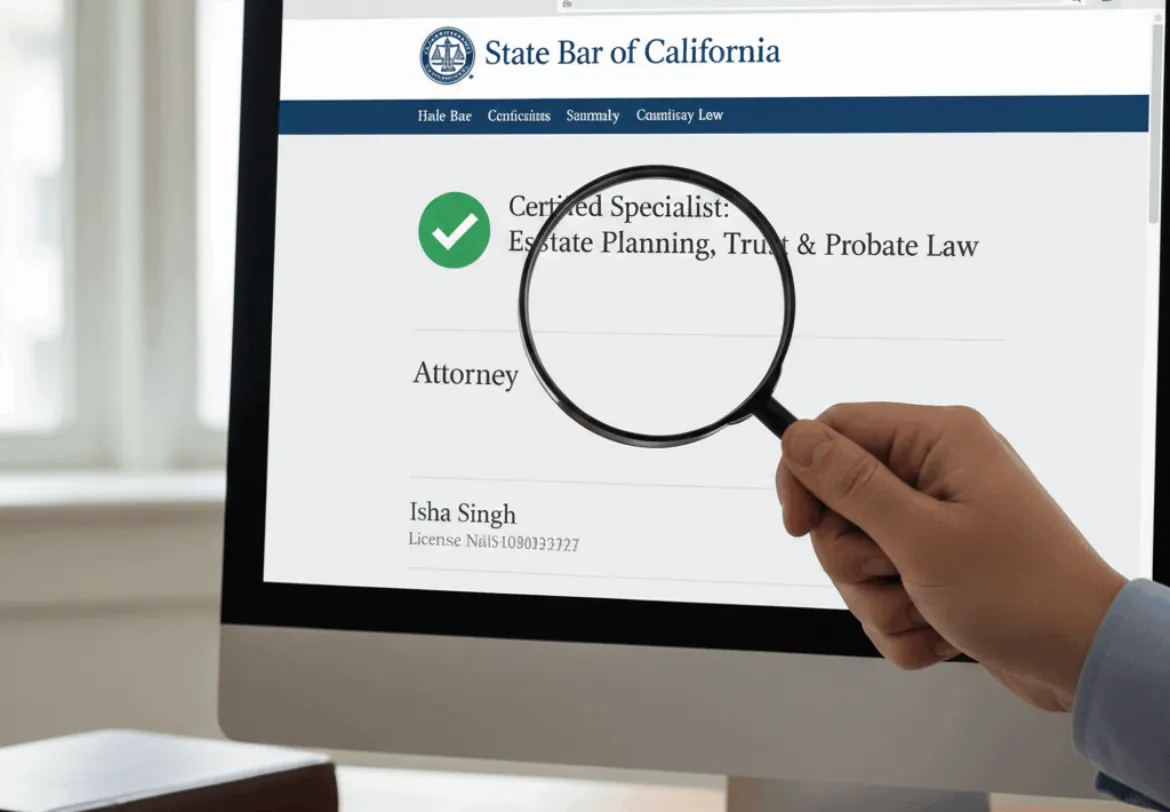
I’m Isha Singh, a California Estate Planning attorney based in Chatsworth. I’ve worked with hundreds of families throughout the San Fernando Valley, and I want to give you an honest, direct answer to the question this post is about – not a generic checklist, but the things that actually matter when you’re choosing someone to help protect everything you’ve built.
I’ll be transparent: the goal of this post is to help you find the right attorney and to make a case that our firm might be that attorney for your family. I think that’s more honest than writing a “neutral” consumer guide that happens to be on my own website.
Quick Summary
The single most important factor is whether Estate Planning is a genuine focus of the attorney’s practice – not a side service offered alongside divorce, personal injury, or criminal defense.
California-specific expertise matters more here than anywhere else – community property, Proposition 19, Trust funding requirements, and Medi-Cal rules are not generic legal knowledge.
Flat-fee pricing is the standard for most Estate Planning – if an attorney quotes you only hourly rates for a straightforward Trust package, ask why.
The attorney should handle Trust funding guidance – not just draft the documents. An unfunded trust provides zero Probate protection.
Credentials that actually mean something: California State Bar active license, Super Lawyers or Best Lawyers recognition, real client reviews with specific stories.
What Kind of Attorney Are You Actually Looking For?
This sounds obvious, but it matters: you need an attorney whose practice is genuinely centered on Estate Planning – not someone who does it occasionally between family law or personal injury cases.
In California, any licensed attorney can legally draft a Trust or a Will. That doesn’t mean every licensed attorney should. Estate planning involves California-specific legal frameworks – community property rules, Proposition 19 property tax implications, Medi-Cal planning, Trust funding requirements – that a generalist may not be current on or equipped to handle correctly.
A good rule of thumb: Estate Planning should represent at least 75% of the attorney’s active caseload. If they describe themselves primarily as a “general practice” attorney who also handles Estate Planning, keep looking.
The difference between Estate Planning and Probate Attorneys
These are related but different practices. An Estate Planning attorney’s job is to build a plan that keeps your family out of court. A Probate Attorney’s job is to navigate the court process after someone dies without adequate planning.
Some attorneys do both – which is fine. But be aware of what one California practitioner described as the “perverse incentive” problem: an attorney whose primary income comes from Probate litigation doesn’t have the same motivation to build airtight estate plans that never need Probate.
The California-Specific Expertise That Actually Matters
California Estate Planning isn’t just Estate Planning with a California address. The state’s legal framework creates specific planning requirements that an out-of-state template or a generalist attorney can easily miss – with costly consequences for your family.
Community property
California is one of nine community property states. Property acquired during marriage is presumed to be owned equally by both spouses – but characterizing separate versus community property, especially for assets acquired before marriage, received as gifts, or inherited, requires careful analysis and documentation.
Proposition 19
Since February 2021, the rules around inheriting California real estate changed dramatically. For a child to avoid property tax reassessment on an inherited home, they must move in and use it as their primary residence within one year of inheriting. The exclusion is also capped.
For San Fernando Valley families with homes that have appreciated significantly over decades, the difference between a plan that accounts for Prop 19 and one that doesn’t can mean thousands of dollars per year in additional property taxes for your children.
Trust funding
A living trust only avoids Probate for assets that are actually titled into it. A trust document that isn’t properly funded – meaning your home and financial accounts haven’t been retitled into the trust’s name – provides no Probate protection at all.
The attorney you choose should either handle the deed transfer for your real property or provide detailed written instructions for how to complete it. Ask this question directly: “Will you help me fund the trust, or do I handle that on my own?”
Medi-Cal planning
For families concerned about long-term care costs, Medi-Cal (California’s Medicaid program) has specific asset eligibility rules and a recovery program that can affect inherited property. California currently uses a 30-month lookback period for long-term care benefits.
Credentials That Actually Mean Something
Credentials worth paying attention to
Active California State Bar license: The baseline. Verify at calbar.ca.gov before hiring anyone.
Super Lawyers: Attorneys are nominated by peers and go through a research process evaluating experience, professional achievement, and recognition within the legal community. It’s not a guarantee of quality, but it’s a genuine peer-review process – not a paid placement.
Best Lawyers: Based on peer review surveys of practicing attorneys. Best Lawyers: Ones to Watch recognizes attorneys who are newer to peer recognition but receiving significant attention from their peers.
Real Google reviews with specific stories: Not star ratings alone – the actual content of reviews. Look for reviews that describe a specific situation, explain what the attorney did, and describe the outcome.
Awards you can ignore
If an attorney’s website has more than a few “Top 10 Attorney” or “America’s Most Honored Professional” badges, treat those as noise. Most of these require a fee to claim and involve no independent vetting.
Red Flags to Watch For
Trust mills
A trust mill is a company – sometimes not even a law firm – that mass-produces generic estate plans through high-volume seminar marketing, often using non-attorney salespeople to conduct the initial meetings. The documents are templated and don’t account for your specific family situation or California’s specific legal requirements.
Jack-of-all-trades practitioners
Be cautious of attorneys who advertise Estate Planning alongside divorce, personal injury, immigration, and criminal defense. Estate planning in California has enough complexity that it rewards specialization.
Pressure to sign immediately
A legitimate Estate Planning attorney will encourage you to take your time, review draft documents carefully, ask questions, and bring in a spouse or trusted family member.
No specific questions about your situation
A good consultation should feel like the attorney is genuinely trying to understand your family, your assets, your concerns, and your goals.
Unclear trust funding process
If an attorney’s process ends at document signing with no clear plan for how your home and accounts get titled into the trust, your plan may be worthless the moment it’s signed.
Questions to Ask in a Consultation
“What percentage of your practice is Estate Planning?” You want 75% or higher.
“How do you handle trust funding after signing?” The answer should involve either the attorney helping directly with deed transfers or providing specific written instructions.
“How does Proposition 19 affect how you’d structure my plan?” Any California Estate Planning attorney should have a substantive answer to this.
“Do you use flat-fee pricing, and what’s included?” Get the full scope in writing before committing.
“What happens when I need to update my plan in a few years?” Amendments should be expected and handled per a clear fee schedule.
“Will I always work directly with you, or might I be handed to a paralegal or associate?” For a boutique or solo firm this should be straightforward.
What Happens After You Sign
Signing your estate plan is not the finish line. It’s the beginning. The documents need to be properly funded and then maintained as your life changes.
Trust funding
Your home, financial accounts, and other significant assets need to be retitled into the name of your trust for the trust to protect them from Probate. Real property requires a deed transfer recorded with the county recorder. Bank and investment accounts require updating account ownership at each institution.
Keeping your plan current
Estate plans are not permanent documents. Life changes – marriages, divorces, new children, deaths of named trustees or beneficiaries, new property, changes in assets – and the law changes too. Review your plan every three to five years, and after any major life event.
Frequently Asked Questions
Can an out-of-state attorney handle my California estate plan?
No – and it’s risky to try. California Rule 5.5 prohibits attorneys not licensed in California from practicing California law.
Is a solo practitioner or a larger firm better for Estate Planning?
For most families, a solo practitioner or small boutique firm offers the right combination: direct attorney access, California-specific focus, and flat-fee pricing without large-firm overhead.
What’s the difference between Estate Planning and Probate?
Estate planning happens before death – it’s the proactive process of creating documents that direct what happens to your assets. Probate happens after death when a court supervises the distribution of an estate that didn’t have adequate planning.
At what point should someone start thinking about Estate Planning?
In California, the honest answer is: as soon as you own a home, have a child, or have anyone who depends on you. The Probate threshold is $208,850.
What does “funding a trust” mean and why does it matter?
Funding a trust means retitling your assets – primarily your home – so that the trust owns them rather than you personally. A trust document that’s been signed but never funded provides no Probate protection.